
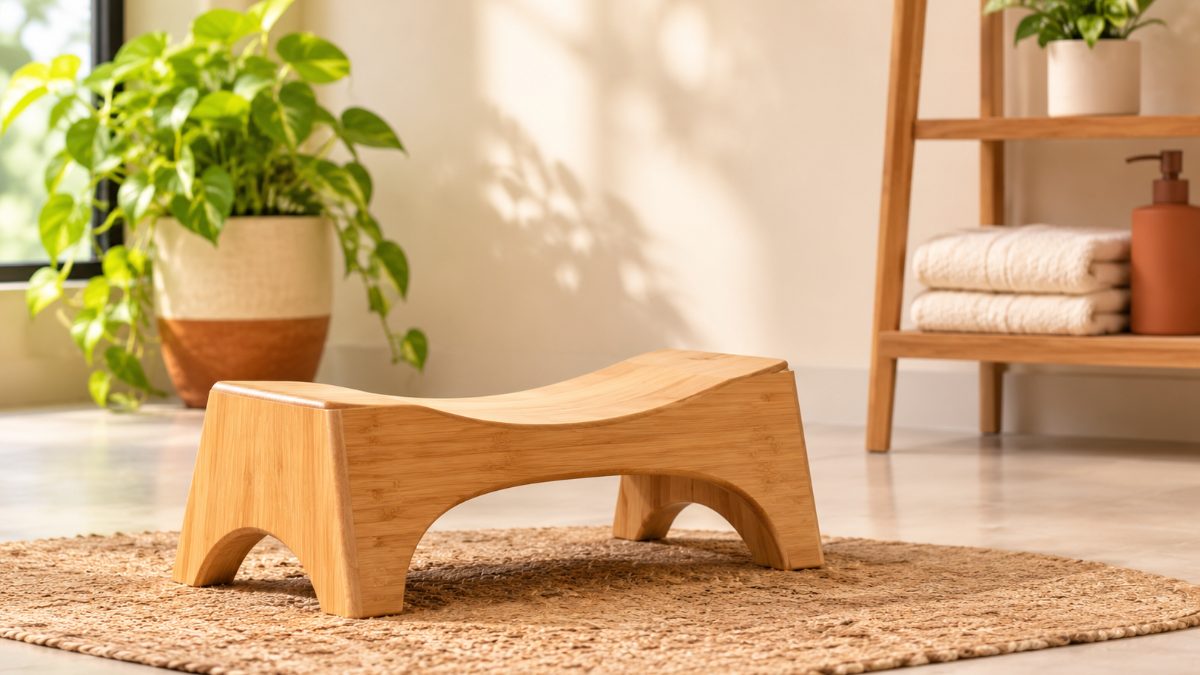
Quick answer: A squat stool raises your knees above your hips while you sit on a western toilet. This relaxes the puborectalis muscle and straightens the passage from the colon to the rectum, so stool passes with less straining and more completely. It is a simple, low-cost tool for constipation, bloating and haemorrhoid prevention, and works best alongside enough fibre and water.
By Janvi Chitalia, Gut Health & Functional Medicine Nutritionist · Last updated: 27 November 2026
As a gut nutritionist, I talk a lot about what we eat, but how we eliminate is just as important. Western toilets put us in a position our bodies were not designed for, and that can lead to straining, incomplete bowel movements and digestive discomfort.
A simple squat stool, also called a toilet stool or footstool, can make a noticeable difference.
Key takeaways
- Sitting at 90 degrees keeps the puborectalis muscle partly tight, kinking the passage stool has to pass through.
- Raising the knees with a stool mimics squatting and straightens that passage.
- In a study of 52 volunteers, using a toilet stool reduced straining, improved emptying and shortened time on the toilet.
- Less straining lowers the risk of haemorrhoids, fissures and pelvic floor problems.
- A stool helps most when combined with fibre, water and a regular routine.
Why does sitting on a western toilet make bowel movements harder?
When you sit upright on a regular toilet, the puborectalis muscle stays partly contracted. It wraps around the rectum like a sling, so the passage stool has to travel through stays kinked. The result is more pushing, longer time on the toilet and a feeling that you haven’t fully emptied.
Squatting relaxes this muscle and straightens the angle, which is why it has been the natural position for most of human history.
What does a squat stool actually do?
A squat stool lifts your feet so your knees sit above your hips, recreating the squatting angle while you stay seated. Research supports it: in a 4-week study of 52 healthy volunteers, using a toilet stool led to more complete emptying, less straining and shorter bowel movements (Journal of Clinical Gastroenterology, 2019).
What are the benefits of using a squat stool?
- Easier, more complete bowel movements. A straighter passage means stool moves out more smoothly and fully.
- Less straining. Straining often and hard can damage delicate tissue and the pelvic floor over time.
- Relief from constipation and bloating. Sometimes constipation is not only about food but also mechanics. Even with enough fibre, poor posture can keep things stuck.
- Helps prevent haemorrhoids and fissures. Less pushing means less pressure on the veins and lining of the rectum.
- Less time in the bathroom. Many people find they are done faster once the posture is right.
How do I use a squat stool correctly?
Use this simple checklist:
| Step | What to do |
|---|---|
| Position | Place the stool in front of the toilet and rest both feet on it, knees above hips |
| Lean | Lean forward slightly, resting forearms on your thighs |
| Relax | Breathe slowly and let your belly relax; avoid holding your breath and pushing |
| Time | Give yourself a few unhurried minutes, ideally at the same time each morning |
| Pair it | Combine with fibre-rich foods, enough water and a short walk after meals |
Does a squat stool replace a good diet?
No. Posture and nutrition work together. A diet with enough fibre from whole grains, pulses, vegetables and fruit, plenty of water and probiotic foods like curd and buttermilk keeps stool soft, and the stool makes it easier to pass. For timing tips, read about the gastrocolic reflex and your morning routine.
When should I see a doctor?
See a doctor if you have blood in your stool or black stools, unexplained weight loss, severe or persistent tummy pain, a change in bowel habits lasting more than three weeks, or constipation that does not improve with diet, fluids and routine changes.
Frequently asked questions
Does a squat stool really help with constipation?
A squat stool improves the angle of the rectum so stool can pass with less effort. A 2019 study found it reduced straining and improved emptying. It works best together with enough fibre, fluids and a regular toilet routine.
How high should a toilet stool be?
Most people do well with a stool about 7 to 9 inches (18 to 23 cm) high, enough to lift the knees above the hips. Taller people may prefer a slightly higher stool.
Can a squat stool help with haemorrhoids?
It can help prevent them, because it reduces straining, a common cause of haemorrhoids. If you already have painful or bleeding haemorrhoids, see a doctor.
Is squatting better than sitting for bowel movements?
For most people, yes. Squatting relaxes the puborectalis muscle and straightens the anorectal angle, making bowel movements easier and more complete.
Can children and older adults use a squat stool?
Yes. Children often benefit because their feet do not reach the floor. Older adults should choose a stable, non-slip stool and get up slowly.
Related reading: Understanding the gastrocolic reflex · 5 foods that help with constipation
Still struggling with constipation or straining? A root-cause gut health consultation can find what is driving your symptoms and build a plan around your body. I see clients online across India and worldwide, and in-clinic in Mumbai.
Book a consultation → or explore my gut health services.
About the author: Janvi Chitalia is an integrative gut microbiome health coach and functional medicine nutritionist, trained with the Institute for Integrative Nutrition (New York) and in functional medicine, with a PG Diploma in Weight Management (University of Chester) and a Fellowship in Clinical Nutrition (Apollo).
This article is for general information and is not a substitute for medical advice. Please consult your doctor for diagnosis and treatment.





Leave A Comment